


NGOs, associations and cooperatives
Include artisan soapmaking in a hygiene, social inclusion or income-generating project, using free and reusable documents.
Share · Train · Empower
APISARA provides a free practical manual, technical guides and a soap calculator for organizations and trainers who teach artisan soapmaking, especially in resource-limited settings, to help people and groups become self-reliant.
PDF · 142 pages · 16.0 MB
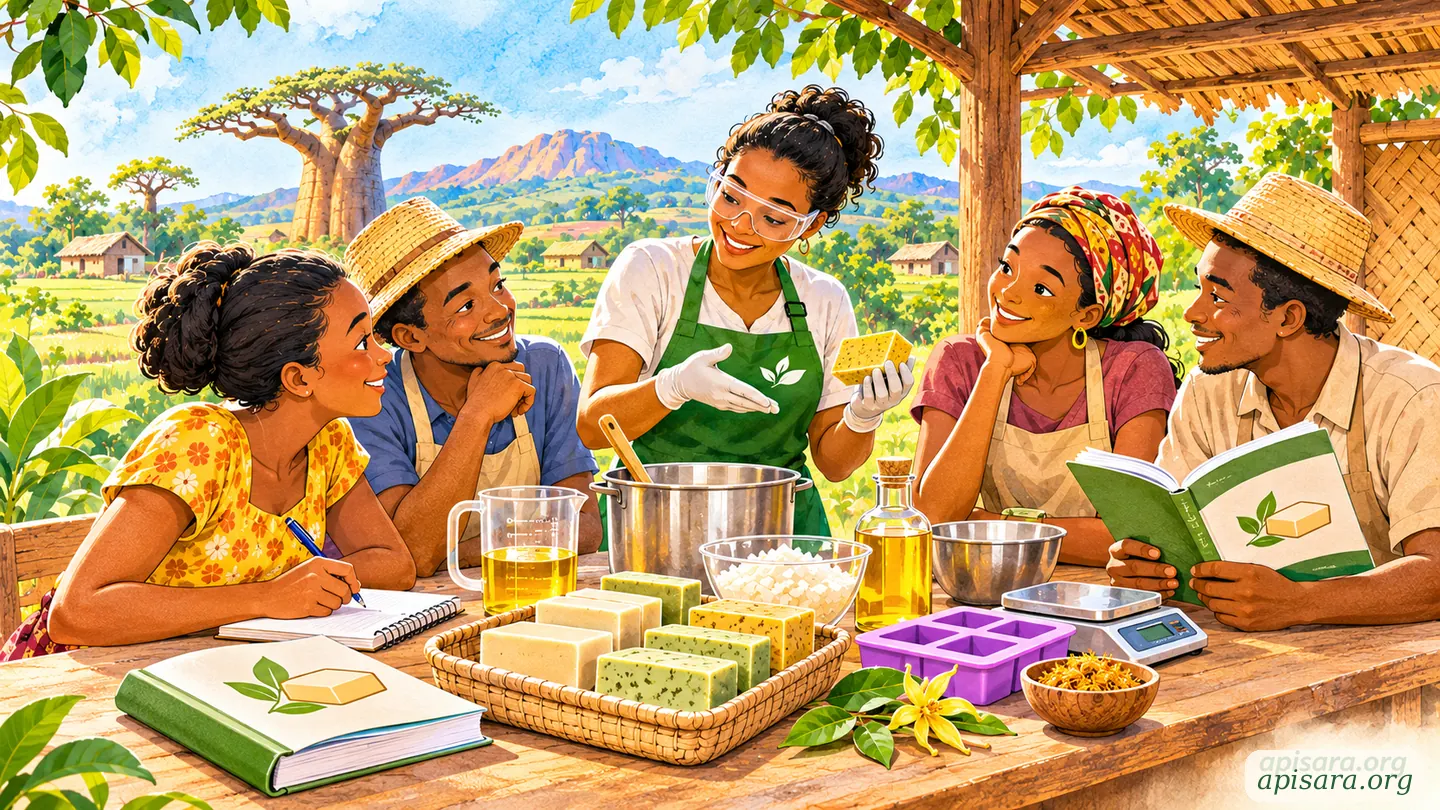
Who it is for
The same free resources can support very different projects. They are available without registration.
Include artisan soapmaking in a hygiene, social inclusion or income-generating project, using free and reusable documents.
Prepare sessions, plan a progression and hand out materials to participants: manual, thematic guides, glossary and calculator.
Organize small-scale production: choice of local raw materials, recipe calculations, cost control, hygiene and consistent manufacturing.
Reuse, print or adapt the documents for non-commercial purposes, following the license and attribution terms below.
Accessible explanations and practical steps support beginners working independently or with a facilitator.
The goal is to identify available raw materials and adapt production methods to local economic and practical conditions.
Technical skills can help community groups and cooperatives develop activities. Costs, product quality and reliable production remain central considerations.
Teaching use
A simple sequence for preparing sessions with APISARA resources:
Read through the manual and select the chapters that suit the group’s level, the time available and the equipment at hand.
Pair each session with the matching PDF guide: oils and butters, lye and saponification, cold process, curing…
Cover lye handling, protective equipment and workshop organization before any demonstration, using the Hygiene and safety guide.
The APISARA calculator is free and needs no account; once installed, it also works offline.
Ask participants to note recipes, batches and observations: these records make follow-up easier and help improve the sessions.
Document license: unless otherwise indicated and subject to third-party rights, original APISARA educational texts and documents are provided under Creative Commons CC BY-NC 4.0 ↗.
Additional permission: the author expressly permits free use and free distribution of these documents in training activities, including paid courses, provided attribution is retained and the files themselves are not sold.
APISARA documents, articles and tools are educational. They do not replace appropriate practical training, technical and safety checks, or applicable rules governing product manufacture and sale.
Materials
The manual and the international panorama are available in four languages. The files are large: on a slow connection, download them once and then share them offline (USB drive, printed copies), in line with the license.

The APISARA practical manual supports self-study and small-group workshops, with an emphasis on local resources, practical skills and income-generating activities.
Also available in: Français (17.8 MB)Português (Brasil) (17.8 MB)Español (11.0 MB)

Explore the APISARA international report on organizations supporting soapmaking in community development. Its 72 profiles describe documented activities, training initiatives, local partnerships and networks working in hygiene and income generation. Each account includes sources and distinguishes completed actions from proposed projects. The report is free and available in four languages.
Also available in: Français (344 KB)Português (Brasil) (306 KB)Español (306 KB)
Contact
Are you using APISARA resources in a training course or a project? Have you found an error, an unclear explanation or information that should be checked? Simply write to:
APISARA is a volunteer project: messages are handled without a guaranteed response time and no support service is offered. Documents and tools can be updated when a specific error or a more reliable source is identified.
Understand ingredients, formulation and manufacturing methods.
Calculate lye, water and estimated recipe properties.
Names, INCI, SAP values, fatty-acid profiles and precautions, taken from the calculator data.